Sound On Sound · November 1988 · David Mellor1
“perfect pitch shifting is not yet with us … until then the H3000 is among the best I have heard.”
He found the reverb less impressive than some dedicated units, but felt it had a character of its own.


Eventide · 1987
The H3000 brought diatonic harmonies, subtle pitch shifts, reverb and delay together in one unit. First unveiled in 1987, the digital processor series later expanded to include modular effects.
01 Overview
The H3000 introduced diatonic pitch shifting: it analyzes the input pitch and creates harmonies that follow the selected key.1, 2 Algorithms
Patch Factory and mod factory, added through later models and upgrades, let users patch together pitch shifters, filters, delays, LFOs and envelope detectors to create new effects.3, 4 Modular algorithms
02 Development and launch
Development began as a stereo redesign of the H969.12 The service manual also describes the original design goal as a stereo pitch shifter.13 Bogdanowicz recalled that the plan was to build a stereo pitch shifter, but the team “got carried away.”12 The finished unit was a multi-effects processor combining diatonic pitch shifting, delay and reverb.1, 2 Ken Bogdanowicz developed the algorithms and Bob Belcher the hardware.12 Dave Derr designed the analog circuitry and helped with the interface and presets.14
First unveiled on October 16–19, 1987, at the 83rd AES Convention in New York.2, 16 Coverage from the show named the H3000 as one of its three most noteworthy new products.17 Launch advertisements appeared in February 1988 magazines; Eventide also lists 1988 as the release year.18, 28 The US price was $2,395;17 the UK price was £1,795 excluding VAT.1 Some reports gave the US price as $2,400.2 British reviewer David Mellor noted that it actually cost less than previous Eventide Harmonizers.1
In 1990, the subsequent H3000-SE won the TEC Award for signal processing technology.21
03 Contemporary reviews
Reviewers praised the pitch shifting, delay and MIDI implementation, while noting output noise and pitch-shifting glitches and artifacts. Opinions on the reverb differed.
“perfect pitch shifting is not yet with us … until then the H3000 is among the best I have heard.”
He found the reverb less impressive than some dedicated units, but felt it had a character of its own.
“THE H3000 IS a professional piece of equipment, the use of which can be likened to playing a game of chess.”
He rated its reverb among the best digital reverbs he had heard, while pointing out output noise and glitches in diatonic shifting.
“this box seems destined for those creative enough to feel limited by lesser devices.”
This review covered the H3000-SE. Despite its relatively high price, he praised the new algorithms and MIDI implementation.
“the H3500’s delay and reverb programs are excellent—perhaps even unparalleled—in producing effects.”
This H3500 review welcomed mod factory’s response to input dynamics and the Ultra-Harmonizer family’s MIDI implementation, but noted pitch-shifting artifacts and less convincing hall and plate reverbs.
“Eventide have been adding to the factory programs supplied with the H3000, in its various versions (which include the H3500) and they have made the unit into probably the most wonderful effects unit on the planet.”
04 Documented use
In recording and live sound, the H3000 has been used to widen vocals and guitars, add doubling and create a sense of space.
On Red Hot Chili Peppers’ Unlimited Love, Ryan Hewitt used Doubler or Micro Pitch Shift settings at +12 and −12 cents to give the lead vocal dimension and width.10
On Chris de Burgh’s “By My Side,” Stephen Tayler occasionally added very slight left and right pitch shifts to the electric guitar delays for extra resonance.30
Marc Carolan used an H3000-D/SE to double vocals for Muse, and later used a hardware H3000 on vocals for Snow Patrol as well.31, 32
A 1994 report described the H3000-S as a studio staple.25 The H3000 remained on sale in 2001, after its successors had arrived. Studio Sound’s Eclipse review noted that, although the newer units were technically more advanced, there was something more immediate and solid about the approachable H3000.26 It entered the TECnology Hall of Fame in 2016.27
In a 2021 interview, Jonathan Low explained that he mixed folklore entirely in the box and that the two hardware units he mainly used for in-the-box mixing were the H3000 and Culture Vulture. He said he used the H3000 because he had not found a plug-in that could produce the same effect.38
05 Design
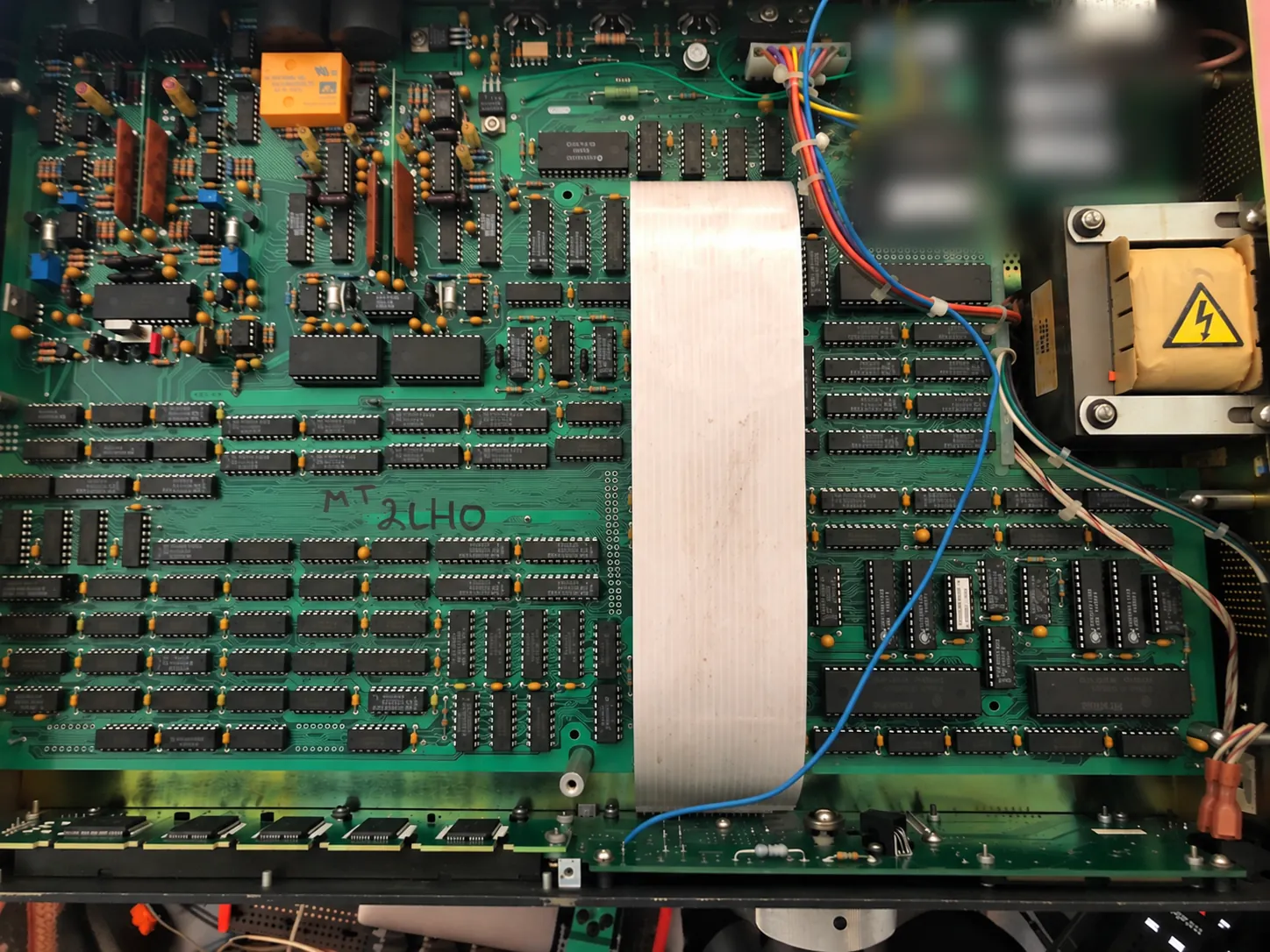
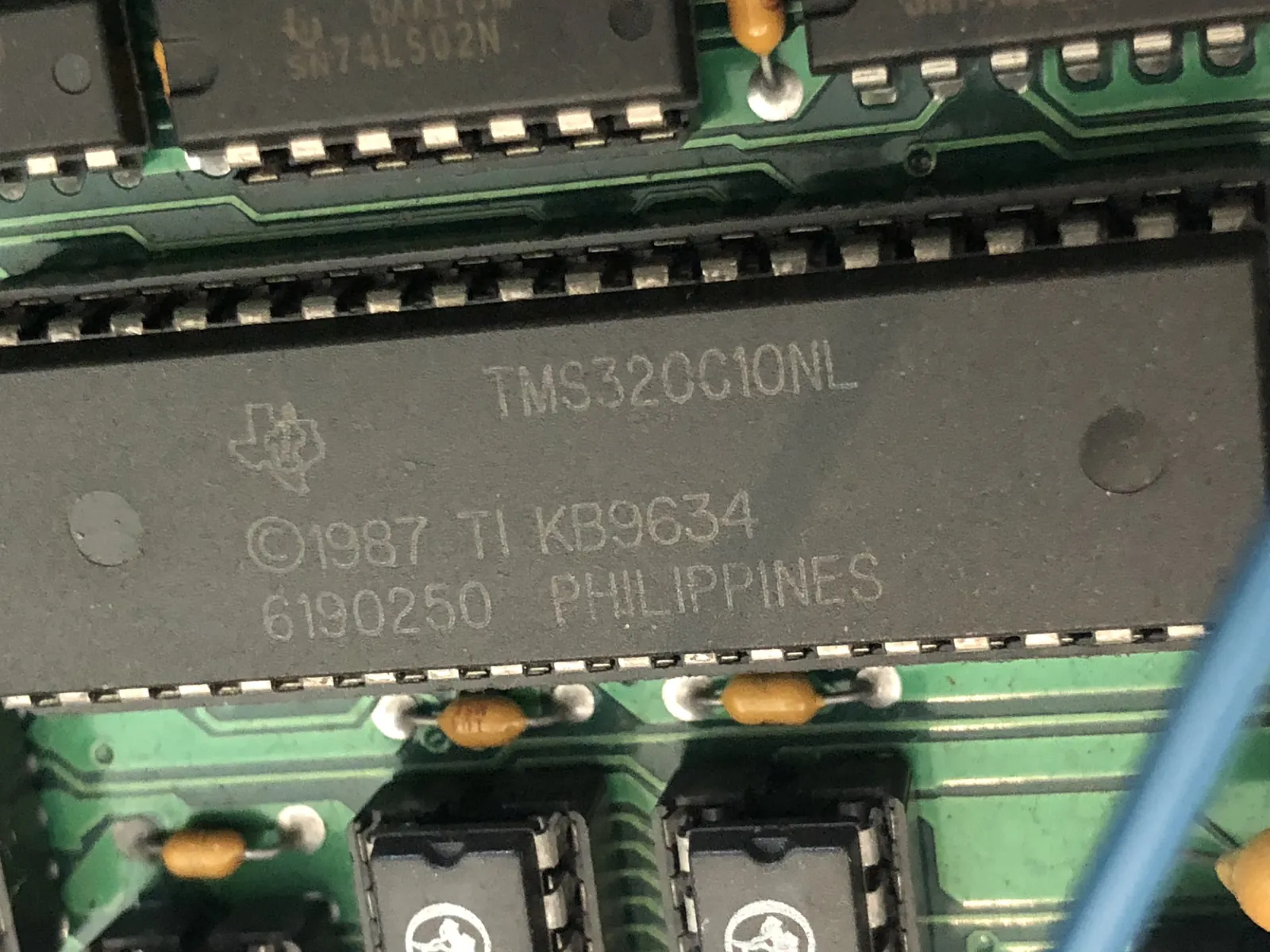
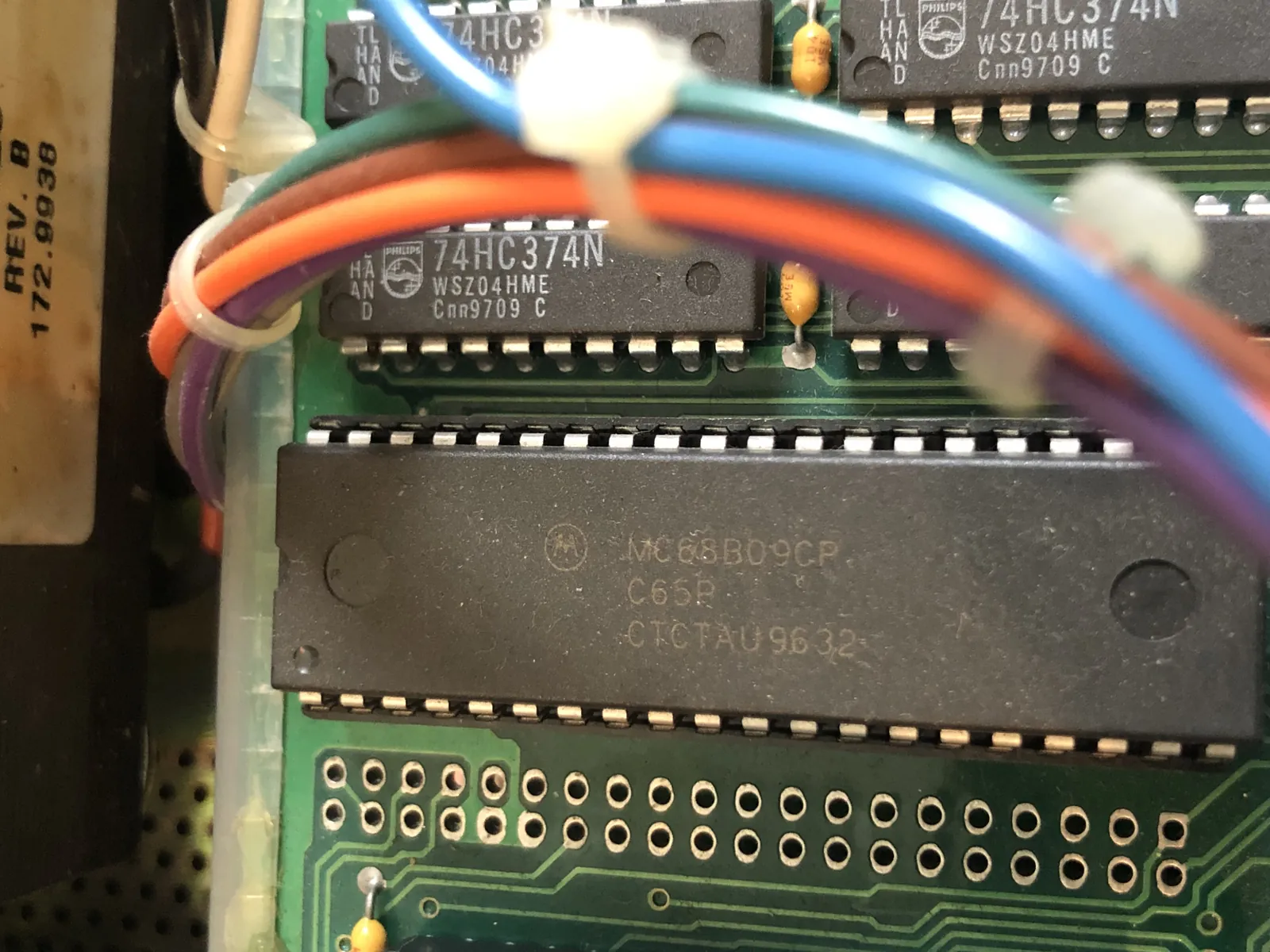
The H3000 processes audio with three Texas Instruments TMS32010 DSPs.43, 44 A separate 8-bit 6809-family CPU handles the front panel and MIDI input, passing programs and parameters to the DSPs.43
The output D/A converters run either on a fixed 44.1 kHz clock, matching the input, or on variable clocks of 22–88 kHz produced by two frequency synthesizers. The service manual describes the variable clocks as a way to change pitch without digital decimation or interpolation filters.45
Designers Bogdanowicz and Belcher presented a paper on multiprocessor-based real-time audio effects processing at the 7th AES International Conference in May 1989.51
Each DSP has 2K words of program memory and time for 104 single-cycle instructions per 44.1 kHz sample period. Branches, subroutine calls and I/O instructions take longer.43 The three DSPs exchange data over a shared bus and three 16-bit registers called mailboxes.13, 43, 52
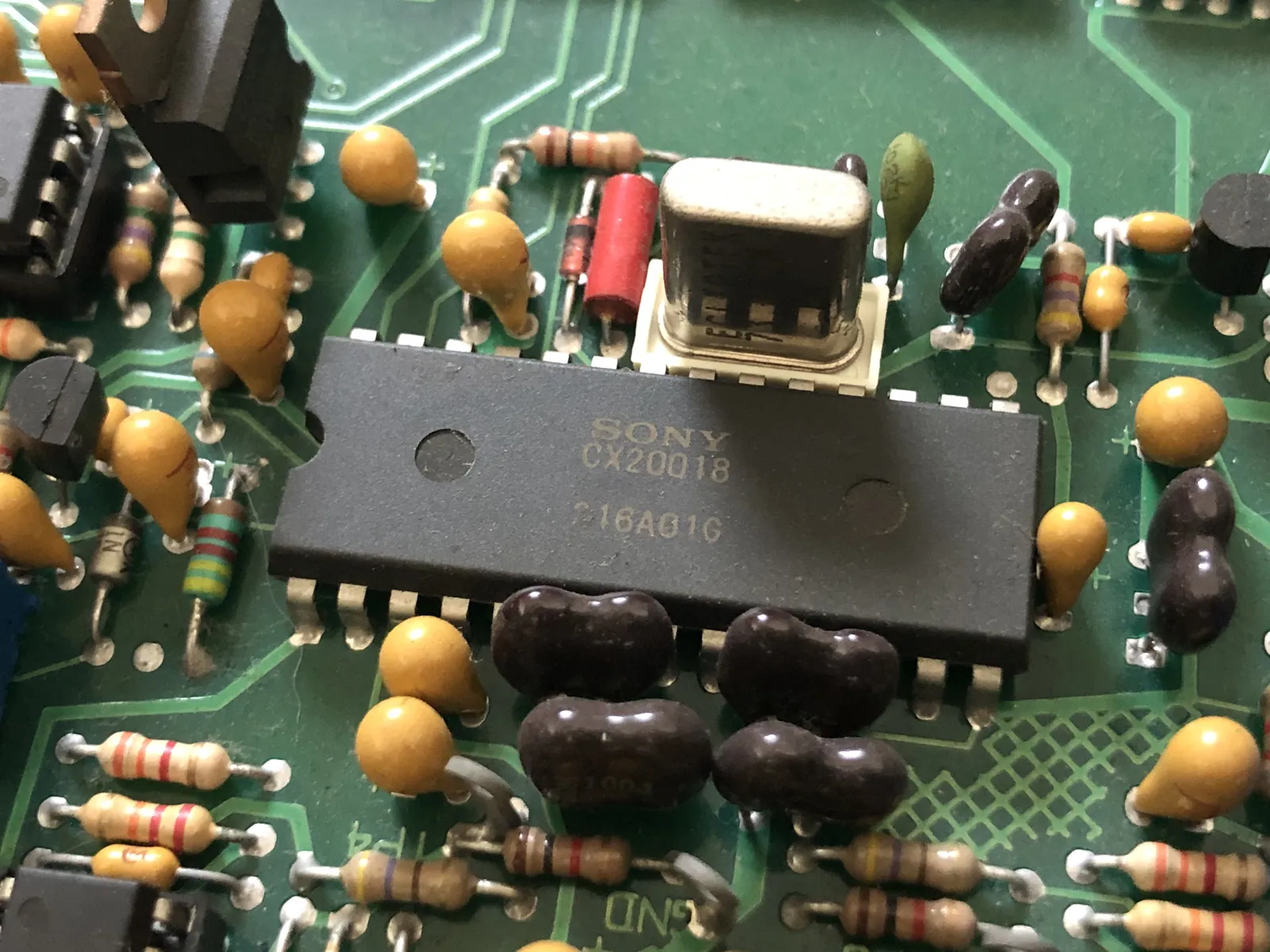
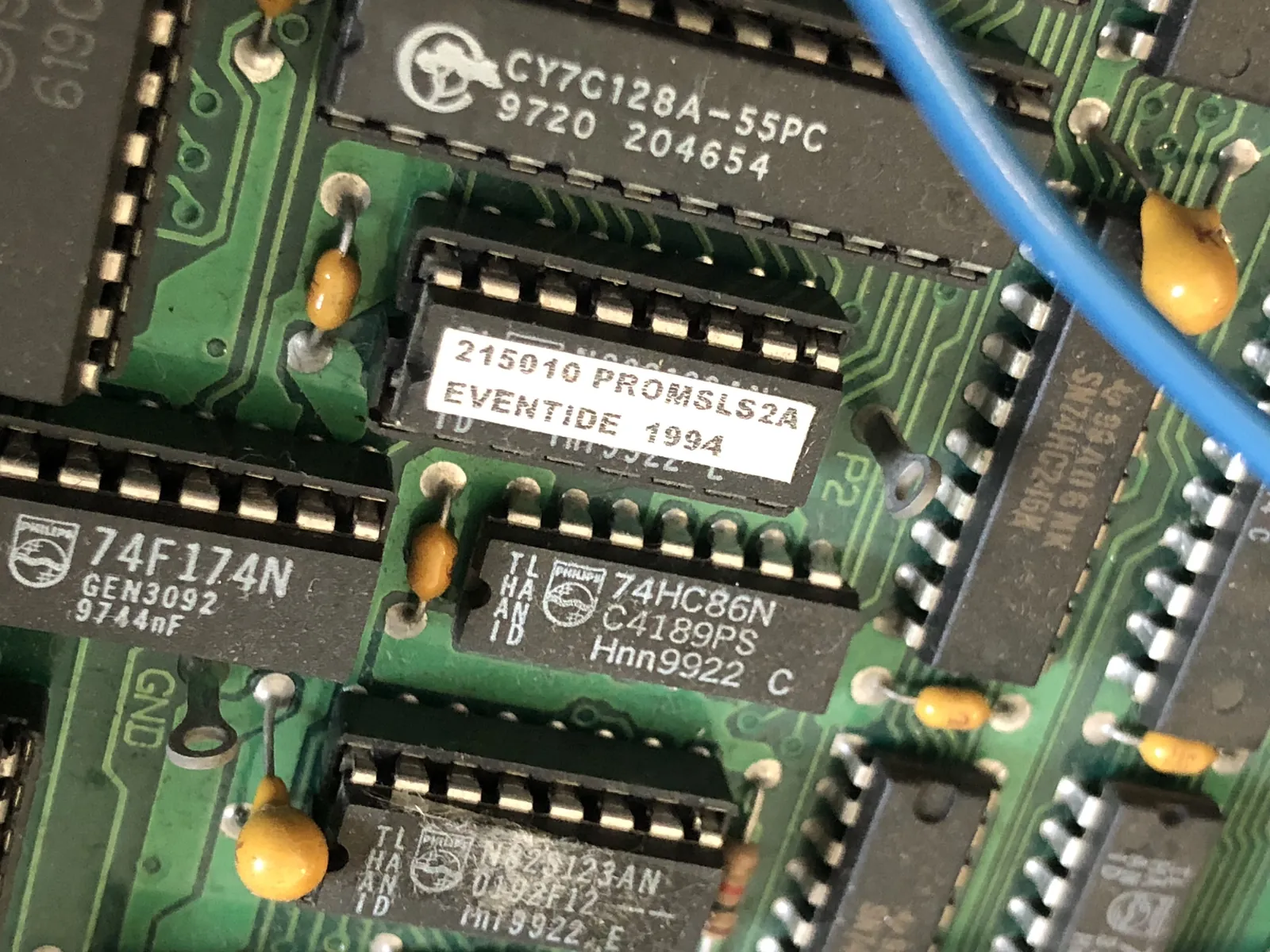
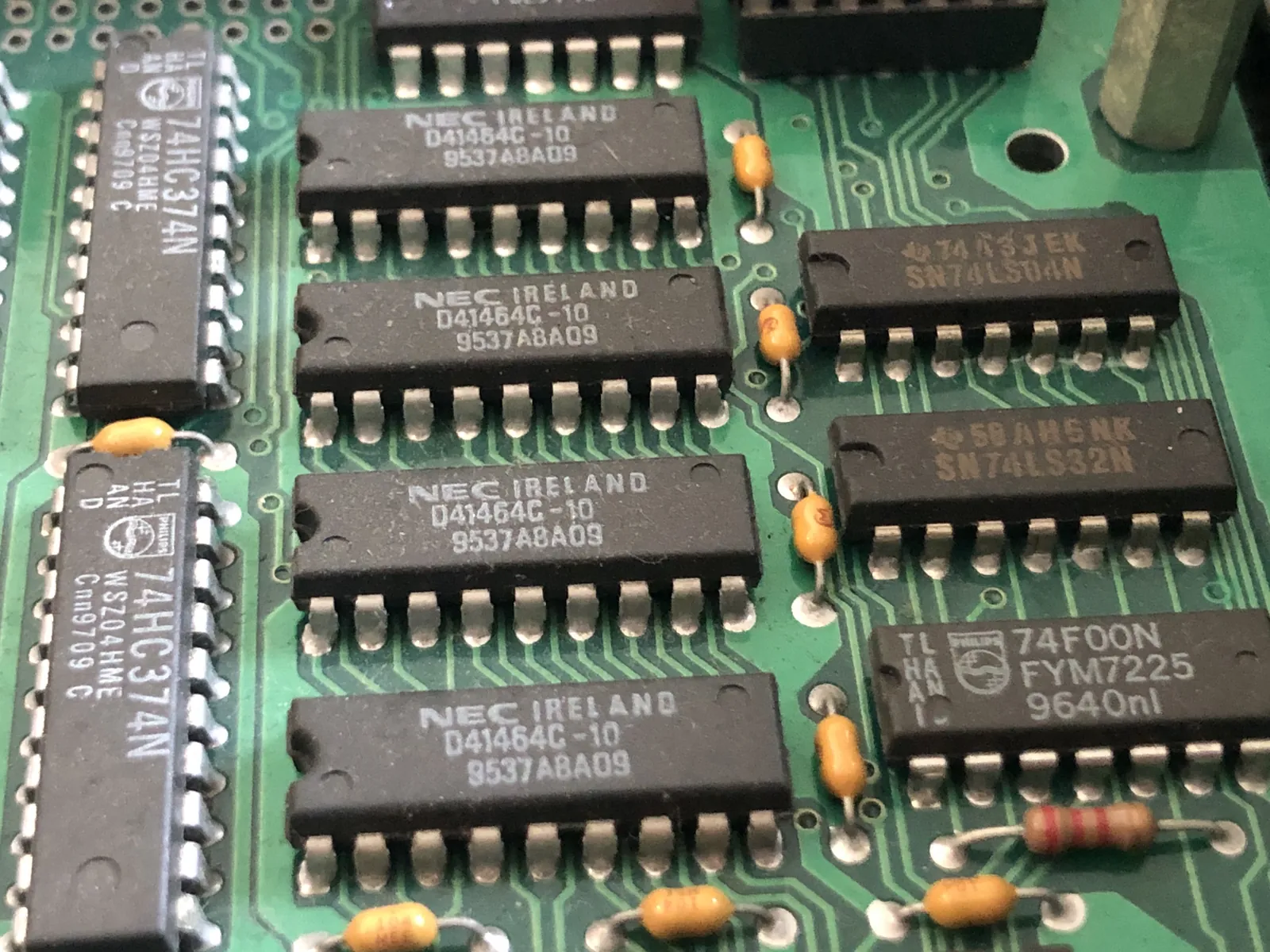
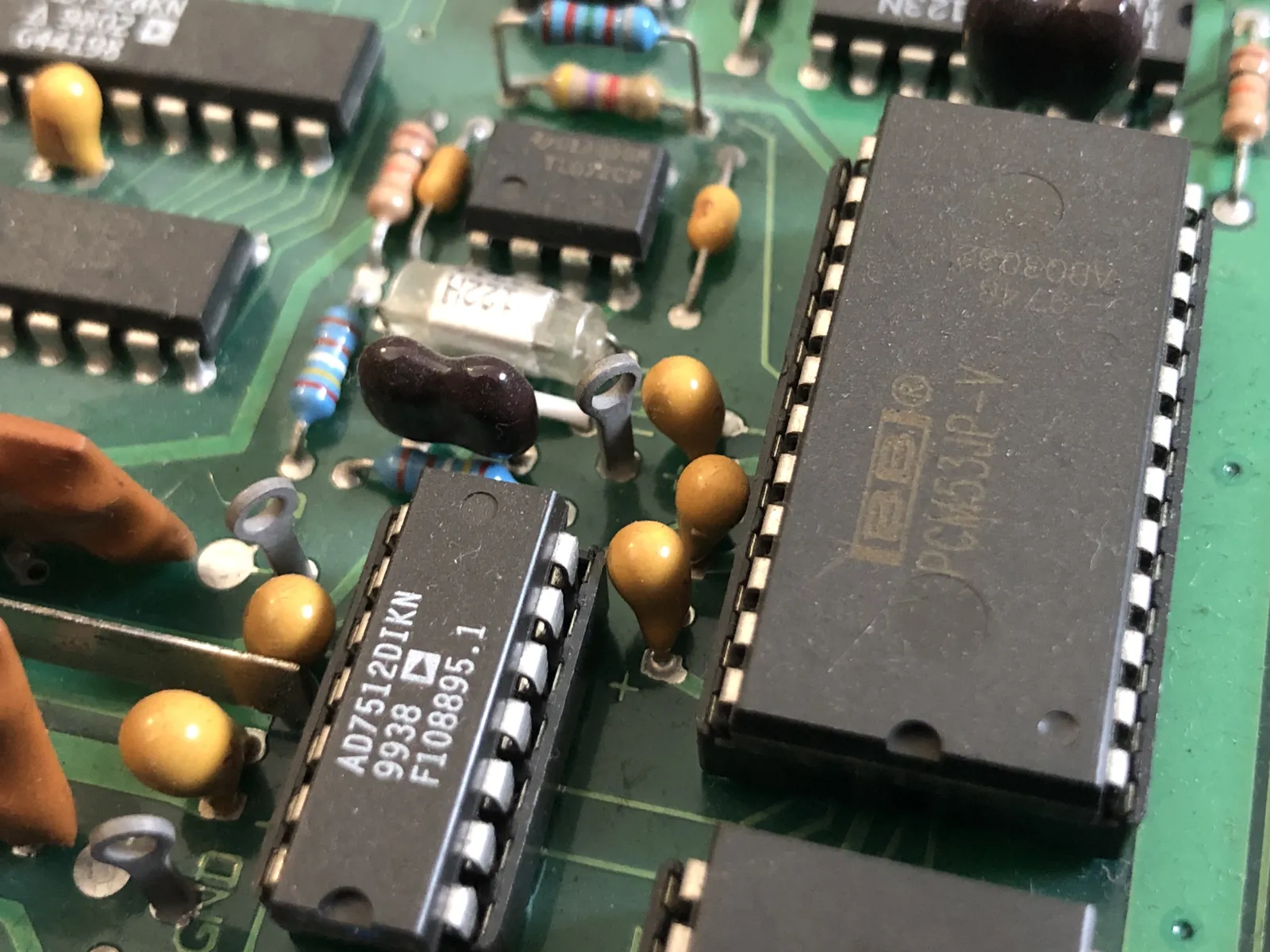
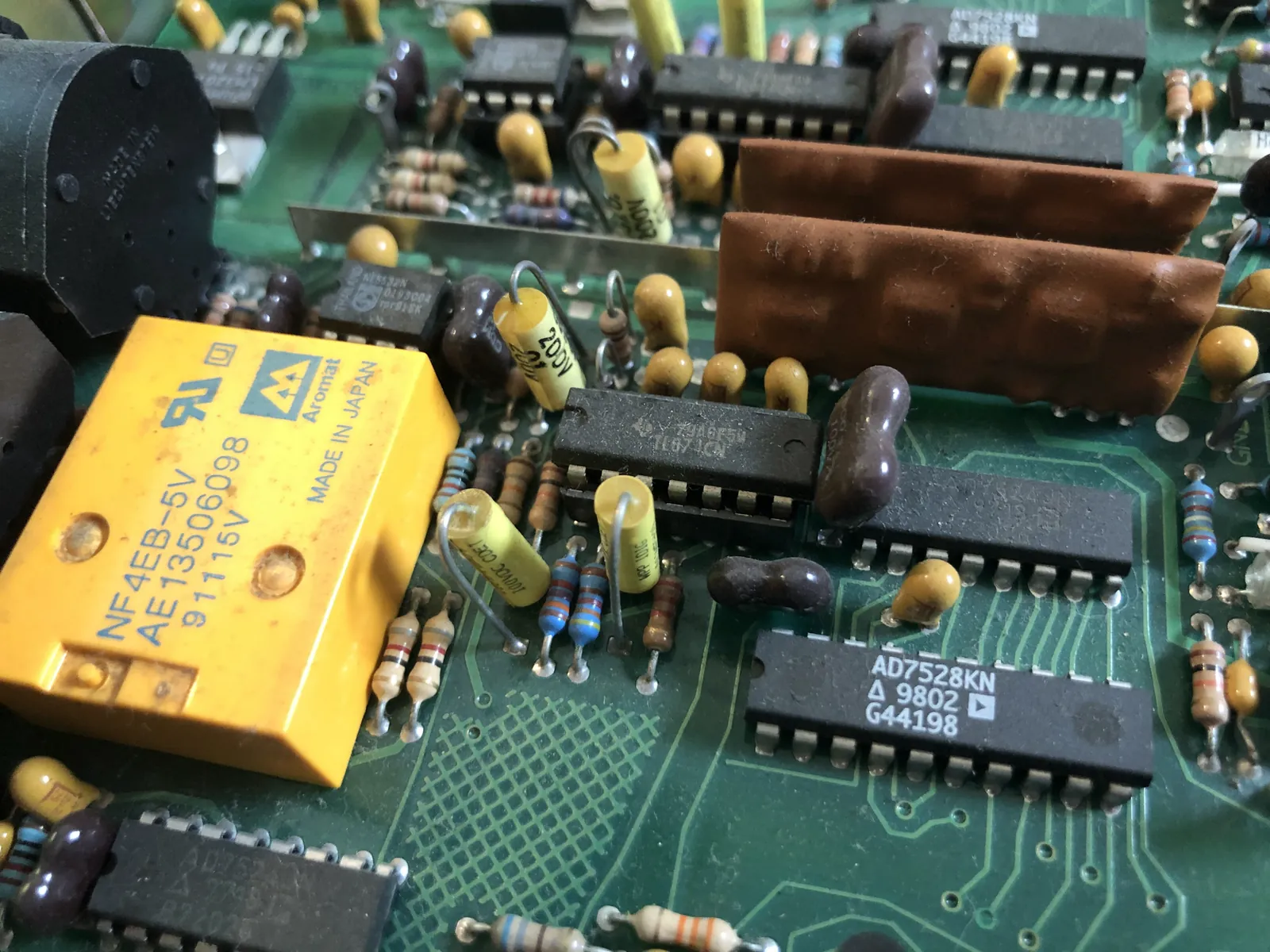
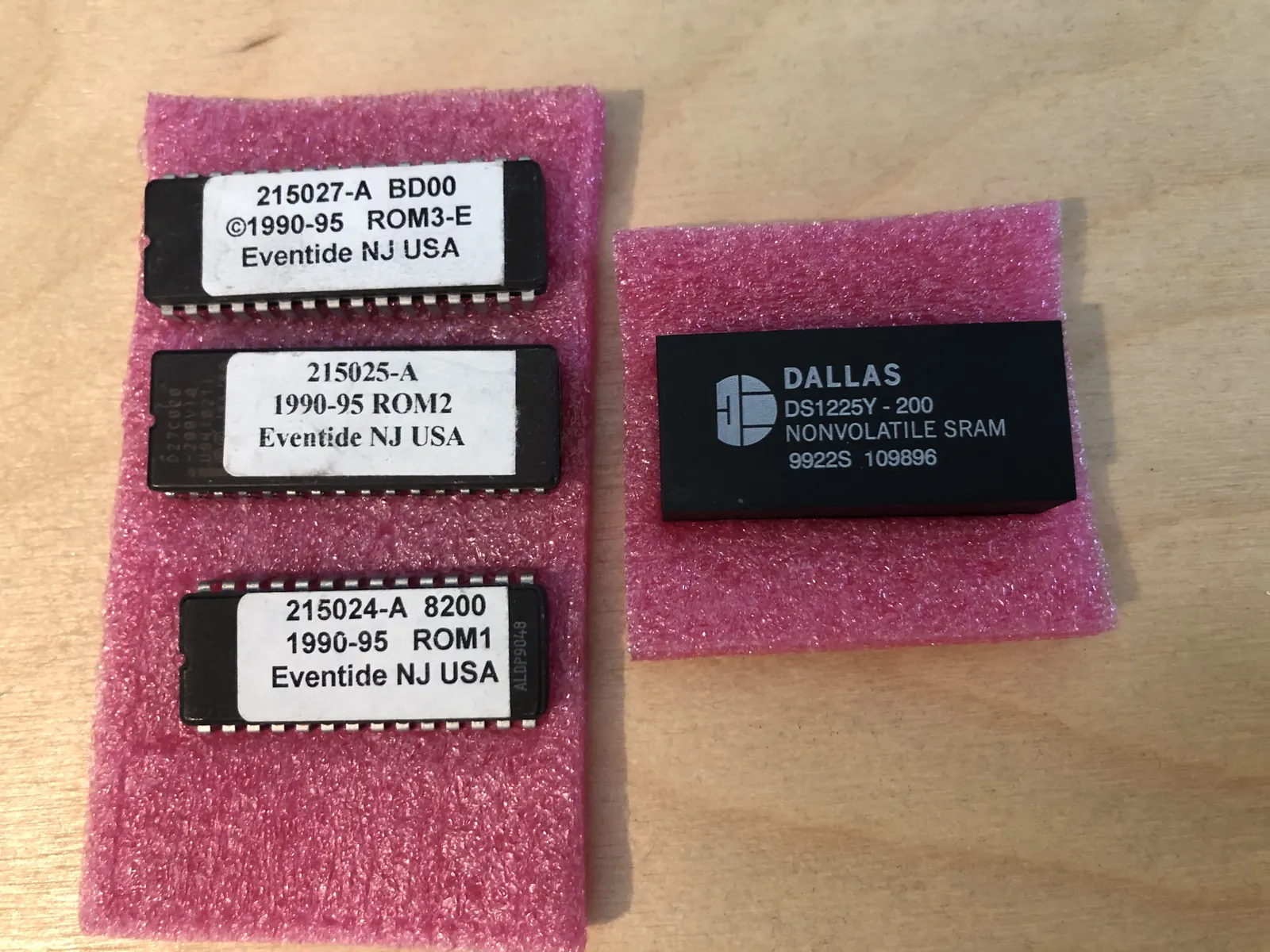
The 64K-word delay memory provides up to 1.5 seconds of delay.45, 46 A single two-channel 16-bit A/D converter (CX20018) alternates between the input channels. Two Burr-Brown PCM53 D/A converters handle the left and right outputs separately.45, 47, 48 User program memory is 8K × 8 bits (8 KB).53, 54
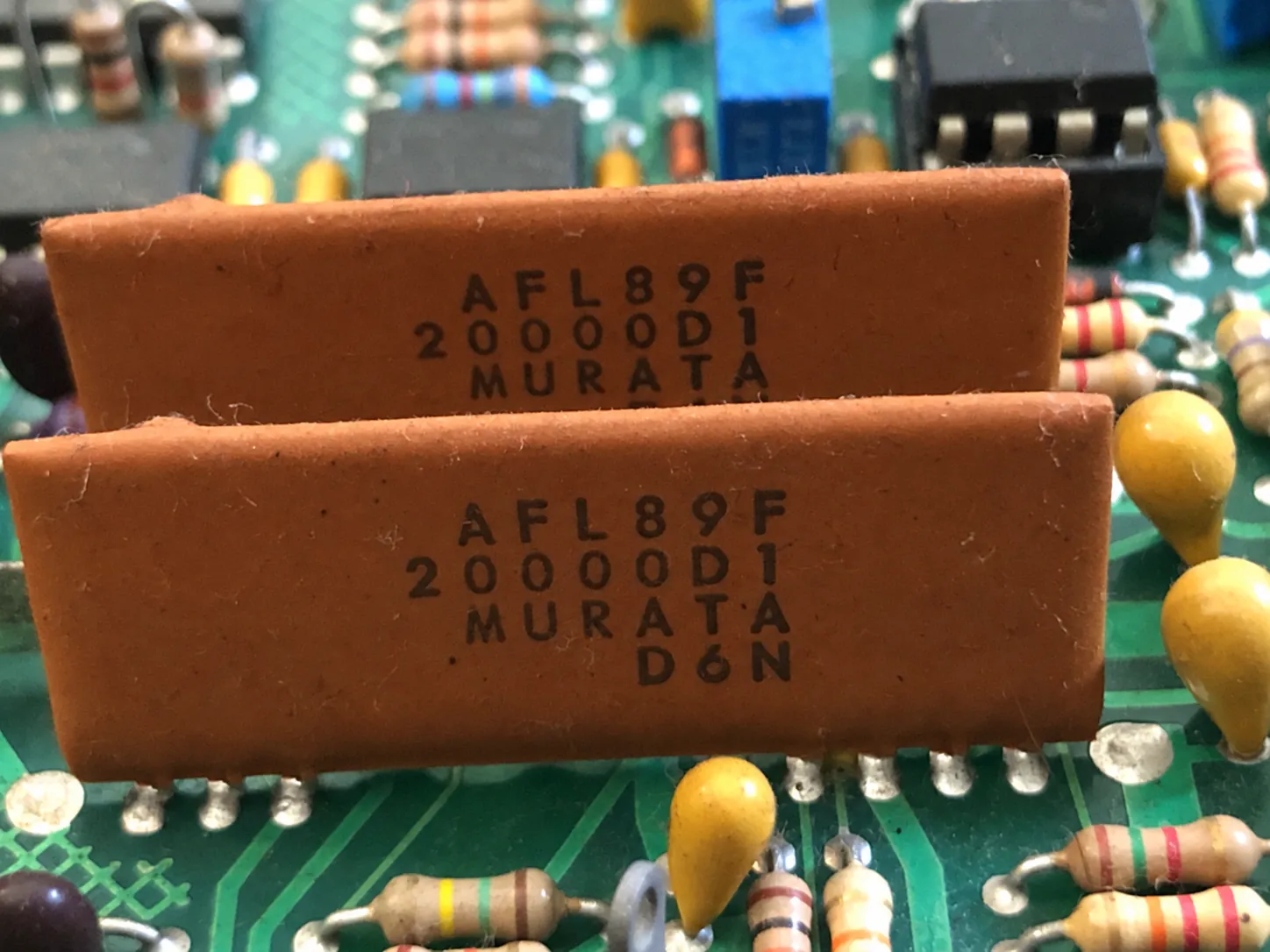
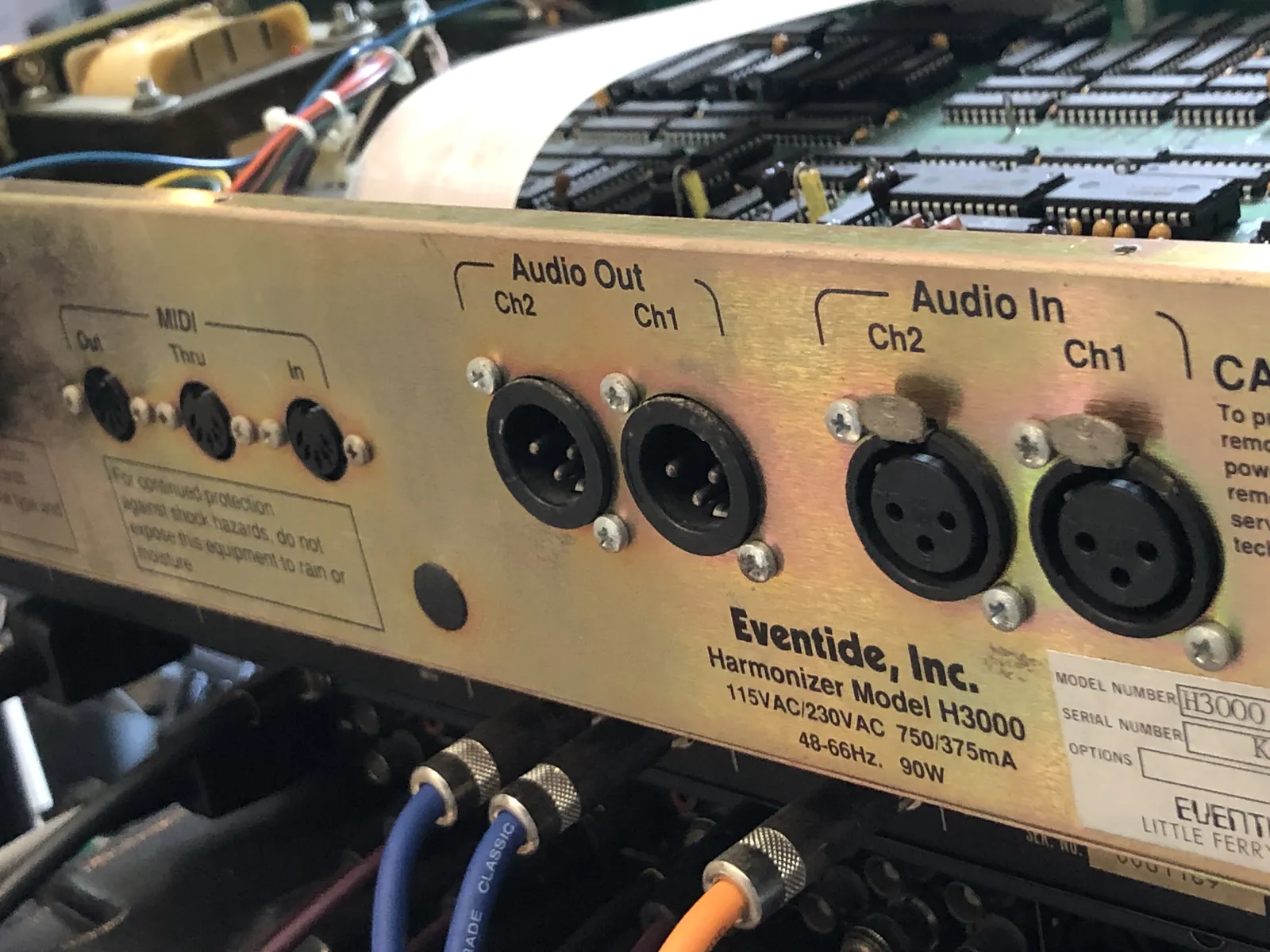
The audio inputs and outputs use balanced XLR connectors.55 Internal jumpers select an input reference level of +4 dBm or –10 dBm.56 Before the A/D converter are high-frequency pre-emphasis and a ninth-order low-pass filter.47 After the D/A converters are the same ninth-order filters, Sin(x)/x correction and de-emphasis.48, 57 Bypass uses relays to connect inputs directly to outputs and engages automatically when power is off.48, 50
06 Interface
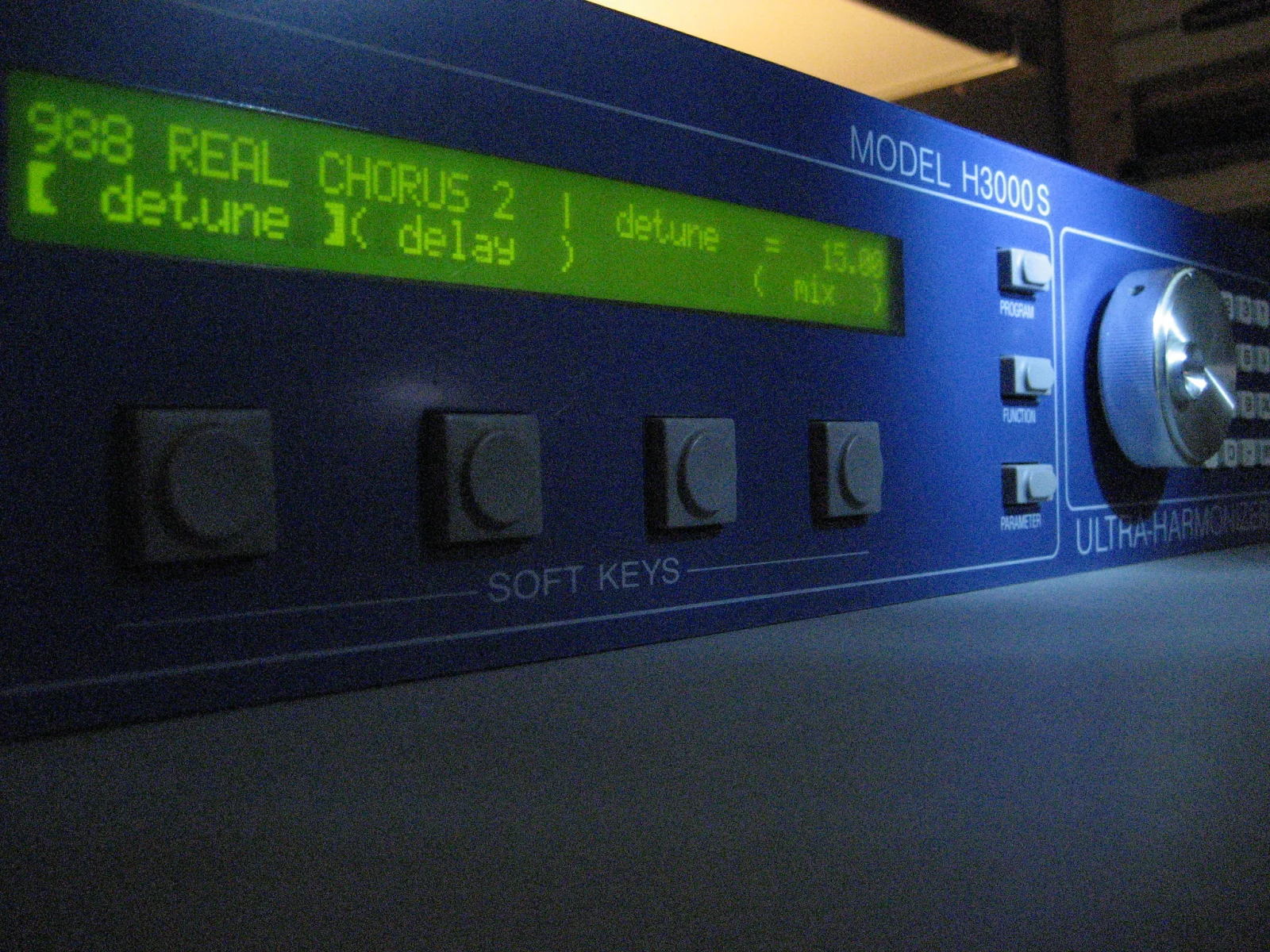
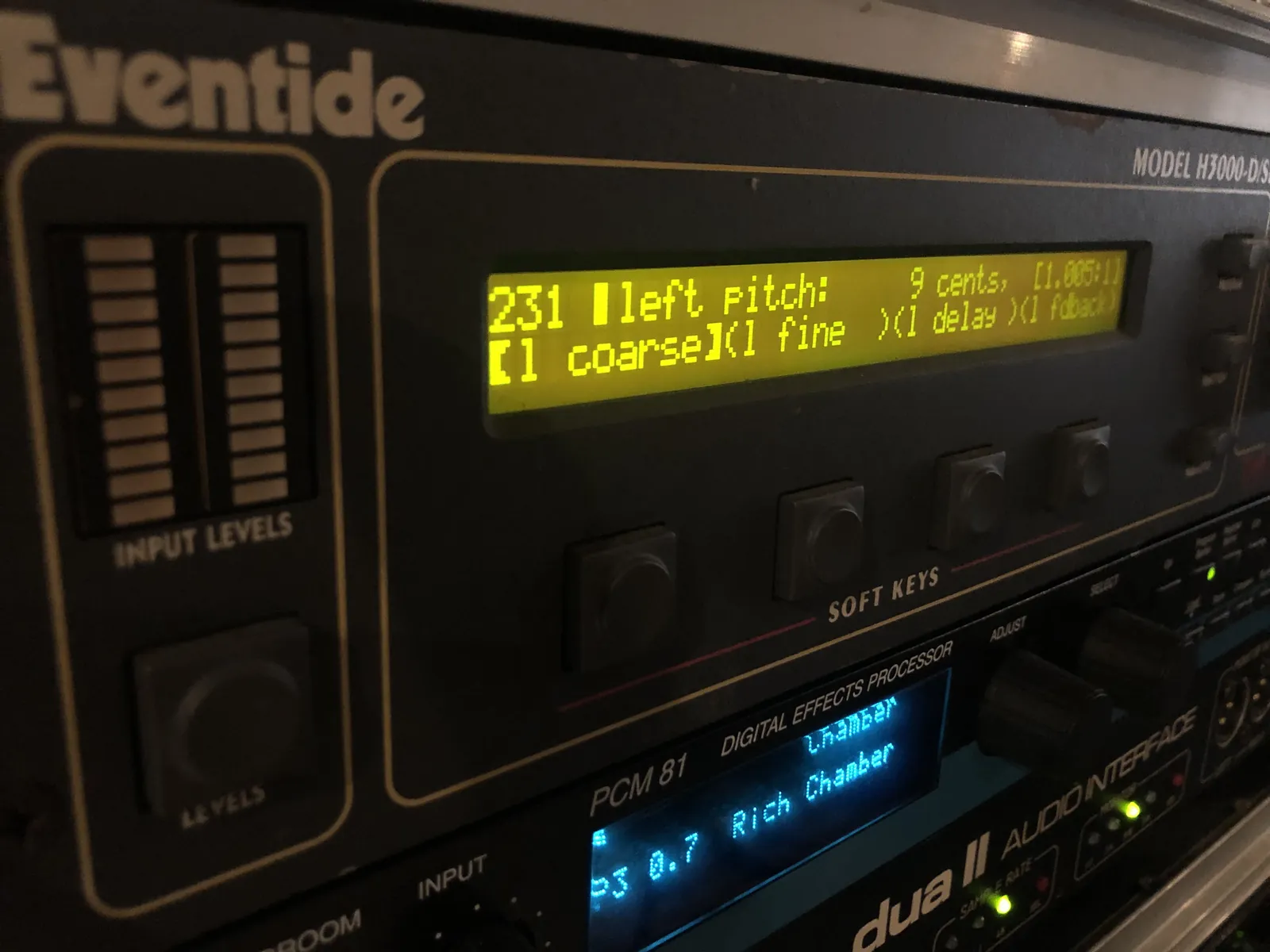
Recall a program by number, then edit its displayed parameters with the knob or keypad.50, 63, 64 The upper line of the 2 × 40-character LCD shows the program number and name, or the parameter or function being edited. The lower line shows the functions of the four soft keys.65, 66, 67 PROGRAM opens program management; FUNCTION provides display contrast, Soft Functions, Function Generator and MIDI settings; PARAMETER opens parameter editing.66
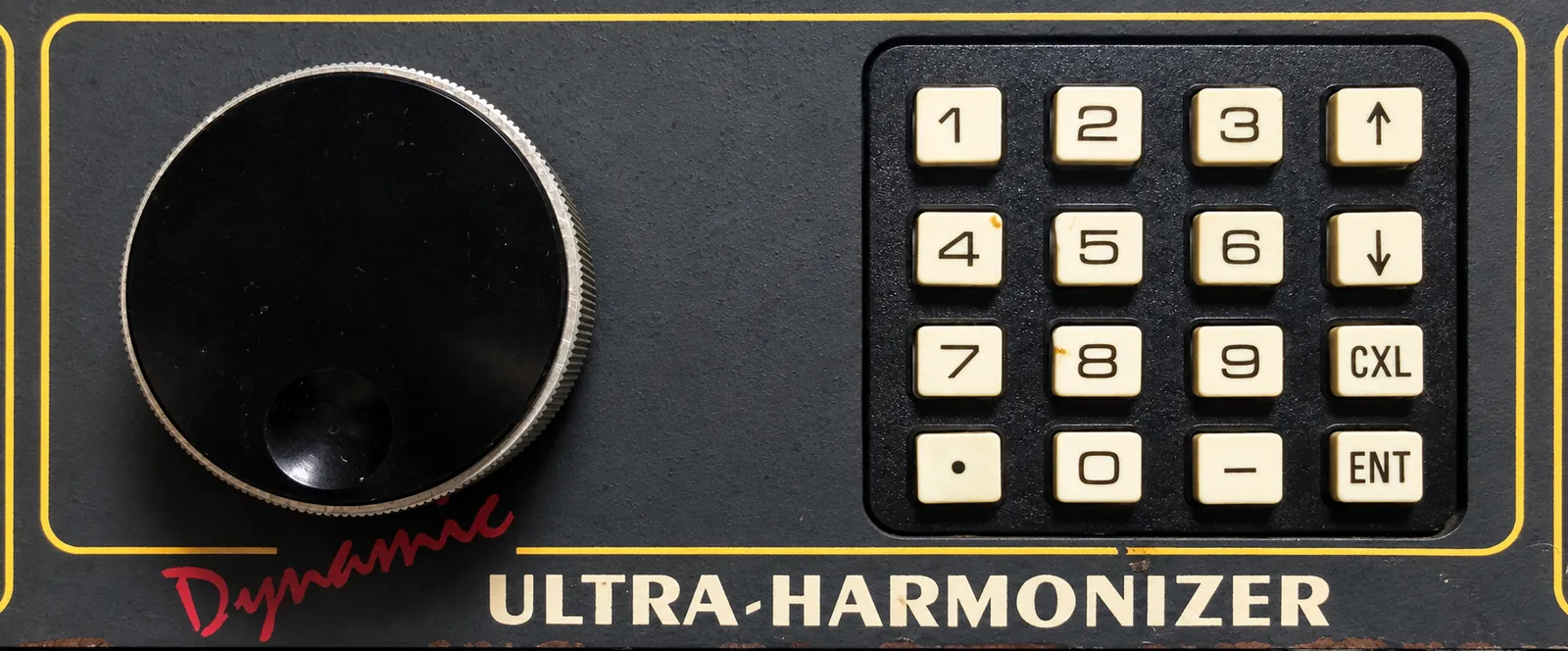
Enter a program number (0–999) on the keypad and press ENT to recall it.50, 68 The Origin soft key displays the algorithm on which the program is based.50
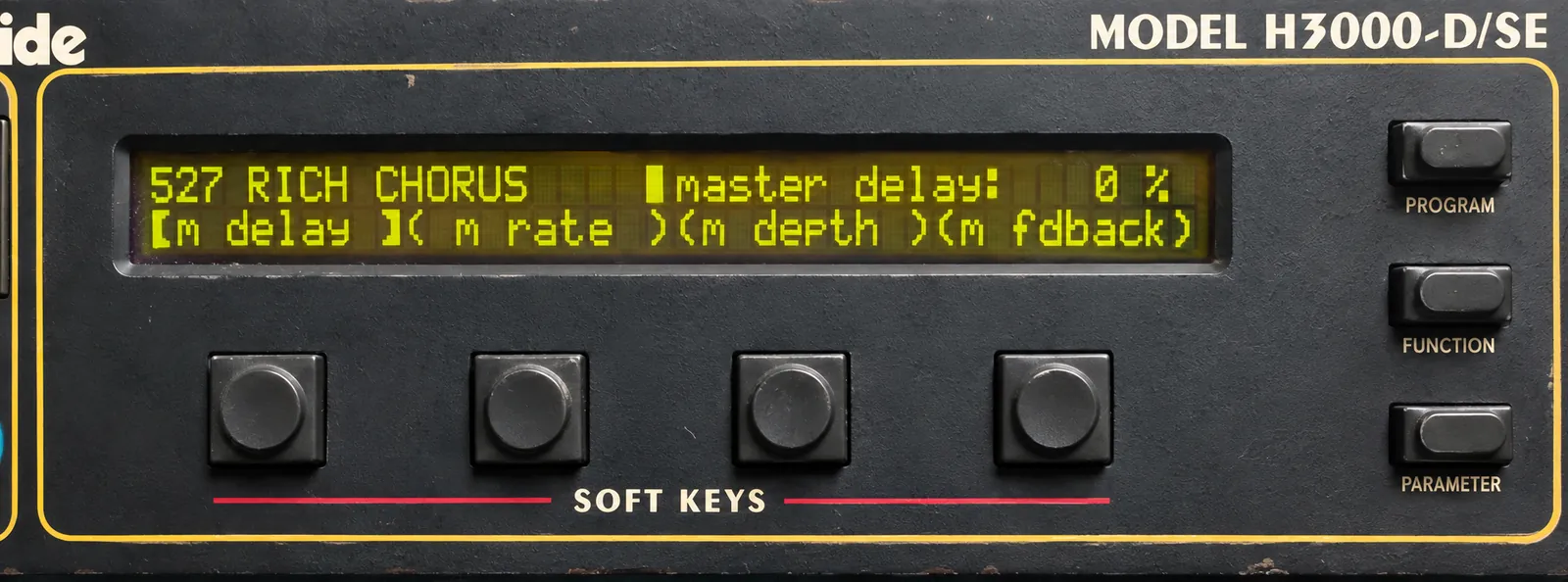
There are three parameter modulation sources: MIDI, the built-in Function Generator LFO, and Soft Functions, which let one control move several parameters at once.63, 69 Each modulation source varies parameters relative to the values set on the front panel.70 Function Generator and Soft Functions were added in software version 2.x.71
07 Capabilities
The first H3000 contained 11 algorithms covering pitch shifting, delay and reverb, numbered 100–110.29, 72 Later models expanded into modular effects, sampling and more.73 In the series, numbers 100–123 identify both algorithms and their default programs; factory presets occupy numbers 150–999.74
Presets range from subtle detuning that widens vocals and instruments to reverse echoes and choruses built from layered delays.
Style I in Soundtoys MicroShift was modeled on #231; Style II on #519.77 Soundtoys Crystallizer also draws on the pitch shifting and reverse echoes of Reverse Shift and Crystal Echoes.78
Presets differ in the placement and tone of their repeats. Low-pass filtered echoes, ping-pong repeats and delays moving across frequency bands create different rhythms and spaces.76
H3000 reverbs include modulated plates, punchy gated ambience for drums, and warm, long rooms.76 Presets with the same or similar names as RICH PLATE, BIG SNARE and BOB’S ROOM also appeared in the Eclipse. Eventide’s cross-reference identifies only #578 BOB’S ROOM as retaining its original number. RICH PLATE and BIG SNARE came from other presets with the same names, #243 and #206.79
Patch Factory (111) and mod factory (122 and 123) let users edit signal routing as well as module parameters. Connecting the inputs and outputs of pitch shifters, filters and delays lets users design the structure of an effect.3, 4
The LFOs and envelope detectors in mod factory modulate delay time, filter frequency, output level and other parameters. They can create delays and sweeps locked to a song’s tempo (30–200 BPM), or duck the delay output as the input grows louder. It came with 100 presets using these modulation capabilities, numbered 800–899.3, 4, 72
mod factory’s COOL PRES, RICH RHYTHM and UNDULATOR create a range of spaces and rhythms, from input-responsive delays to repeats layered with chorus and tremolo.76
08 Series
The H3000 series shared its basic hardware, expanding capabilities through ROM changes and expansion boards.3 Factory presets grew from 50 in the first model to over 400 in the H3500, which had 23 algorithms.1, 3, 29, 80 Figures vary by source. Eventide lists 100 presets for the first model;5 H3500 reviews list either 404 or around 450 presets,3, 80 and either 23 or 20 algorithms.24, 80
mod factory is an algorithm package created by Crescent Engineering.23, 81 Introduced for the H3000 in March 1992,23 it was included as standard in the H3500 released that year.4 H3500 reviews noted that mod factory and the sampling algorithms had previously been options for the 3000 series, available as a $250 upgrade for existing units.24, 80 By 1994, mod factory was standard in the B+, B/LT, D/SX and D/SE.5, 75 The D/SX was announced as adding mod factory, a 19-waveform Function Generator and a six-octave Multi-Shift algorithm to the original 11 algorithms and presets.25
| Year | Models | Main changes |
|---|---|---|
| 1987 | H3000 | Original model, algorithms 100–110 (11 total).1, 72 |
| 1988 | H3000-S (Studio) | Same algorithms, with additional presets and features.5 |
| 1989 | H3000-SE (Special Edition) | Additional algorithms; 200 presets.3, 19, 29 |
| 1989 | H3000-B (Broadcast) | Broadcast algorithms and presets; tape machine speed control through Timesqueeze. Eventide’s history dates it to 1990.5, 19, 82 |
| 1992 | H3500 | SE features plus mod factory (algorithms 122 and 123, 100 presets) and a sampler card (11.8 seconds stereo; 47.5 seconds on the dfx/e).4, 73, 81 |
| 1994 | H3000-B+ · B/LT | B plus mod factory. The B/LT omits Timesqueeze and the tape speed control hardware from the B+.5, 75 |
| 1994 | H3000-D/SX · D/SE | Adds mod factory.5, 75 |
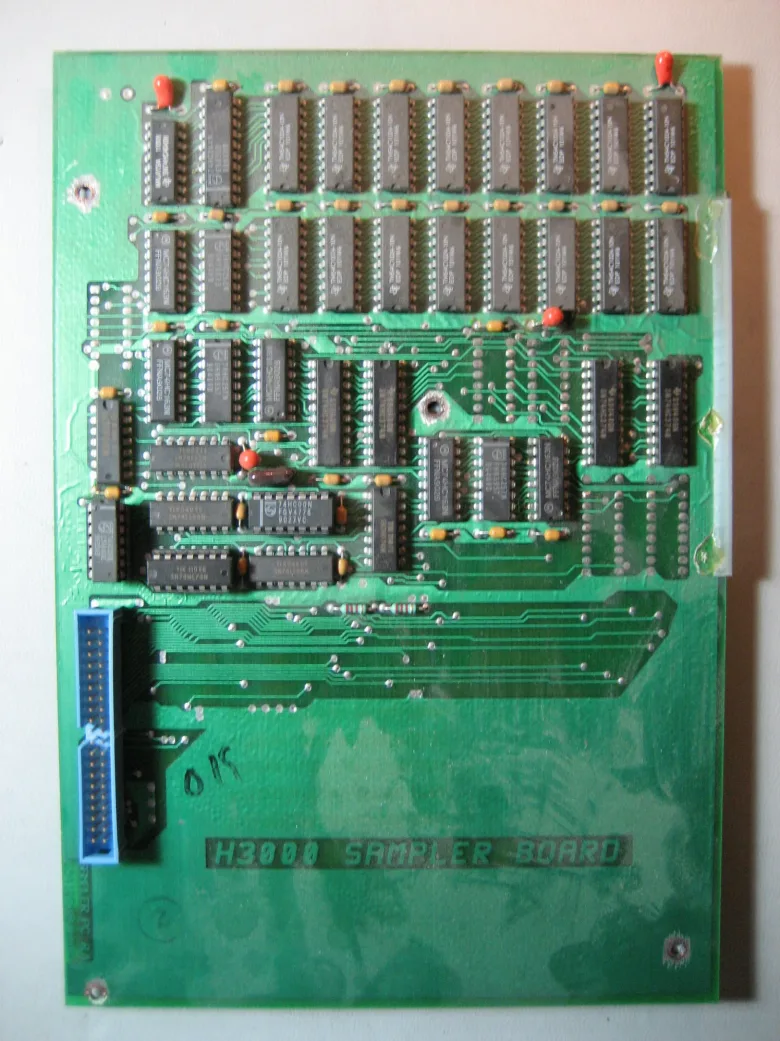
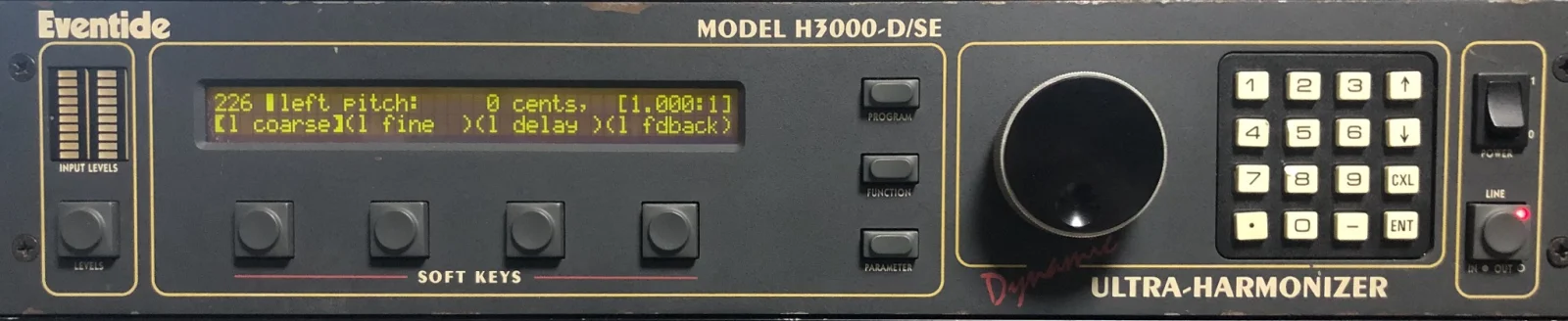
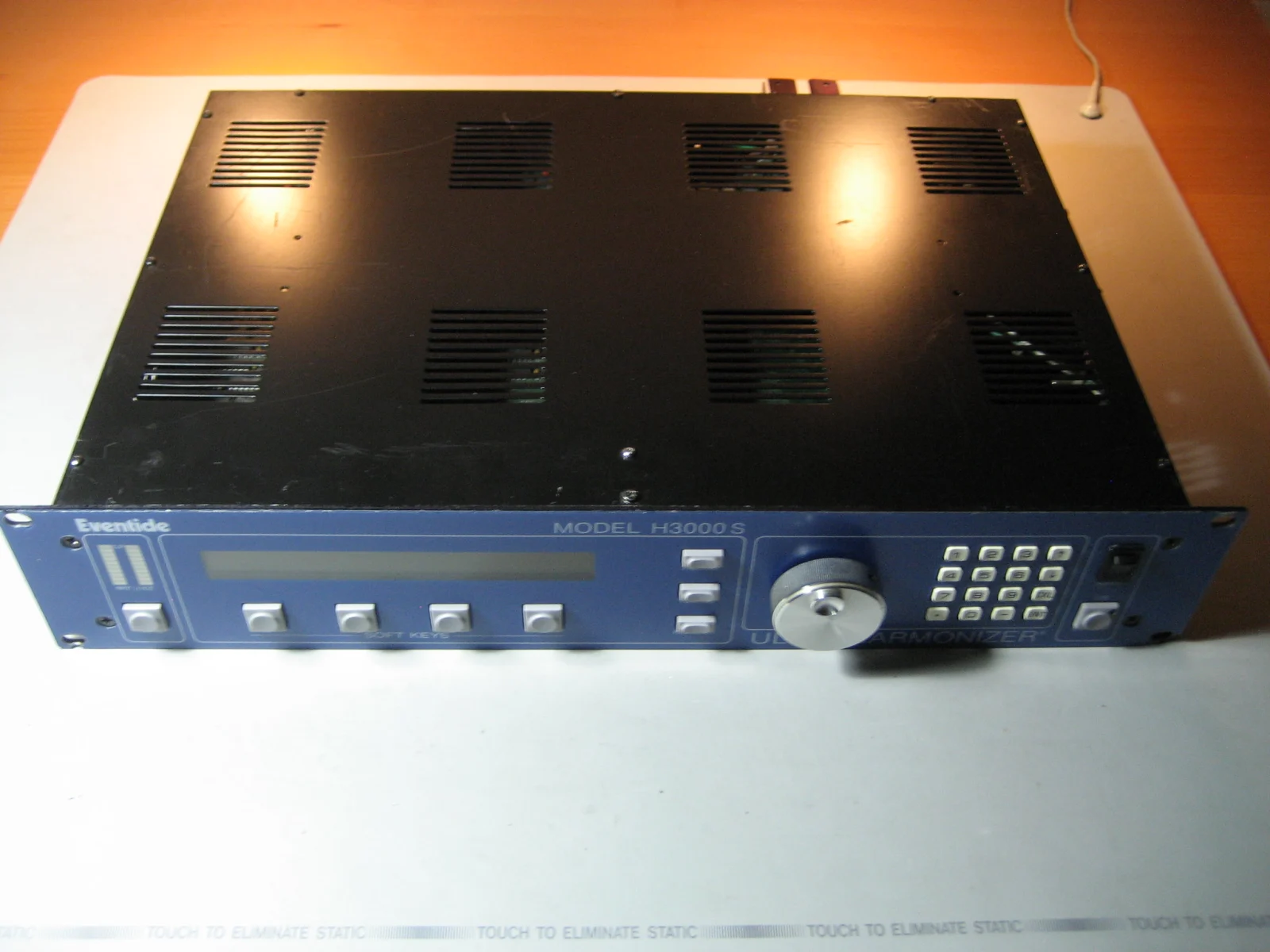
Photo 2 shows a unit upgraded to SE while retaining its S front panel.58
09 Today
The H3000 remains in studios and touring racks after factory repairs have ended. Owners and independent repair shops now keep the units running.
A 2003 Eventide technical note attributed most problems to connectors rather than failed components.85 In 2014, an employee said factory repairs were still available but could be expensive.86 In March 2016, Eventide said it could no longer support or repair the unit; that October, it noted that the one person familiar with it had retired.87, 88 In 2020, it said nobody with that knowledge remained.89 An Eventide reply shared by a user in 2022 stated that no parts remained, including the self-test ROM.90 Archived official store pages show model conversion kits in 2007, only a battery-backed memory chip by 2015, and the last archived listing for that chip in 2017. The service manual, sold for a fee in 2012, is now available free alongside the user and D/SX manuals.72, 91
In reported forum posts, repair accounts and used listings, power supply issues—transformer hum and shorted tantalum capacitors—appear most often, followed by connectors (Molex power connectors and IC sockets), EPROMs, battery-backed memory, displays, switches and jog wheels. Common symptoms include units that power on and display normally but sound wrong, and units that freeze during boot.92 These are counts of reported cases, not failure rates. One report describes a unit stopping during recording with “Uh Oh... TMS320 Loading Error.”93 The battery is integrated into the memory chip, so the whole chip must be replaced, erasing saved presets and settings. The service manual gives a battery life of 10 years; a 2004 technical note says around five.53, 94
Repair accounts usually begin with inexpensive steps: cleaning or reseating power connectors and pressing socketed chips firmly into place,85 then initializing memory by powering on while holding FUNCTION. The manual describes initialization as a procedure for rare cases.98 Next come battery-backed memory replacement, capacitor replacement and replacement of parts such as D/A converters or filters.92 Repair providers have changed too. Studio Electronics, an independent shop Eventide recommended when it ended repairs in 2016, listed typical repair costs of $275–475 in its 2008 archived page and $820 in 2022.87, 99 It disappeared from Eventide’s list around 2024. Its current Eventide notice says it no longer works on digital models.99, 100 Eventide currently lists independent repair shops in two US locations, Paris, Hamburg and Glasgow.101
Many units in use today are no longer in factory condition. OLED display kits, new power supplies to eliminate transformer hum and battery-free memory kits are sold,102 as are replacements for the discontinued Murata filters.96 Since official upgrade kits disappeared, third-party EPROM sets have become a common way to add H3500-level algorithms and presets.92, 93 We found no evidence that these sets were authorized by Eventide. Displays and power supplies sit outside the audio path, while filters, D/A converters and capacitors are within it. An H3000’s sound today may therefore depend on its service history. We found no measurements quantifying those differences.
Physical H3000s still appear in touring racks in the 2020s. Beyond the examples above, an engineer on Bruno Mars’ 2026 tour reported using one on vocals,104 while a Weezer tour engineer said he brought an Eclipse or H3000-D/SE only to shows that did not involve air travel.105 Reasons for continued use include the lack of a plug-in producing the same effect,38 the presence of “that sound,”32 and the String Modeller algorithm and converter texture unavailable in other models.106 Other engineers have moved entirely from outboard equipment to plug-ins.107
Used prices have risen. Across 753 Reverb transactions, annual median prices were about $1,200 in 2017, $2,300 in 2021 and $2,650 in 2026. The H3000-D/SE was the most traded model. These figures cover Reverb transactions only, excluding eBay.108
The 1996 manual includes advice for long service: set the rear voltage selector correctly (115 or 220 V), keep upper and lower vents clear because “heat is the enemy of reliability,” and save presets before receiving a MIDI dump. It lists input XLR pin 3 as hot.98 Users therefore advise checking pin 2 and 3 polarity when connecting other equipment.109
Eventide offers the user manual, service manual and D/SX manual as free downloads.72 In 2024, users decoded MIDI dump data and released an H3000 editor.106 In 2025, a user published a table of algorithms and presets across all models.110
John R. Southern, Flickr, CC BY-SA 2.0 — 1 “IMG_1479” · 2 “IMG_0969” · 17 “IMG_1072”
Our own photographs, H3000-D/SE — 3 · 4 · 5 · 6 · 7 · 8 · 9 · 10 · 11 · 12 · 13 · 14 · 15 · 16 · 18
This account draws on magazine articles and interviews, Eventide manuals (the 1989 service manual, 1992 H3500 manual and 1996 combined manual), manufacturer material and publicly available photographs. Manual page numbers refer to PDF pages. All links were checked on October 14–19, 2026.
abcdefgh David Mellor, “Eventide H3000 Ultra Harmonizer,” Sound On Sound, November 1988, pp. 54–58. https://www.muzines.co.uk/articles/eventide-h3000-ultra-harmonizer/4013
abcd Bob O’Donnell, “Digital Days & Digital Nights,” Music Technology, December 1987, pp. 38–41. https://www.muzines.co.uk/articles/digital-days-and-digital-nights/2142
abcdefghij David Mellor, “Hands On: Eventide H3000 Series,” Sound On Sound, April 1993, pp. 82–88. https://www.muzines.co.uk/articles/hands-on-eventide-h3000-series/10556
abcdefghi Eventide, H3500 - dfx Sampling Ultra-Harmonizer Instruction Manual, first edition, March 1992 (print).
abcdefghijklm Eventide, “Timeline”, 1974–1994 entry. https://www.eventideaudio.com/timeline/
ab Mark Prendergast, “Brian Eno,” Sound On Sound, October 1990, pp. 52–57. https://www.muzines.co.uk/articles/brian-eno/7300
ab Mike Lethby, “U2: The Unforgettable Tour,” Recording Musician, November 1992, pp. 14–19. https://www.muzines.co.uk/articles/u2-the-unforgettable-tour/2968
ab Dan Daley, “Tour de Force,” Sound On Stage, February 1997, pp. 28–32. https://www.muzines.co.uk/articles/tour-de-force/13612
ab Tom Doyle, “Aaron Dessner: Producing folklore And evermore,” Sound On Sound, March 2021. https://www.soundonsound.com/people/aaron-dessner-producing-folklore-and-evermore
abc Paul Tingen, “Inside Track: Red Hot Chili Peppers ‘Black Summer’,” Sound On Sound, July 2022, web page 2. https://www.soundonsound.com/techniques/inside-track-red-hot-chili-peppers-black-summer?page=2
ab Paul Tingen, “Inside Track: Depeche Mode ‘Memento Mori’,” Sound On Sound, June 2023. https://www.soundonsound.com/techniques/inside-track-depeche-mode-memento-mori
abc Walt Szalva, “Ken Bogdanowicz: Behind The Gear with Soundtoys,” Tape Op 62, November/December 2007. https://tapeop.com/interviews/62/ken-bogdanowicz
abc Eventide, H3000 Service Manual, first edition, October 1989, PDF p. 4. https://cdn.eventideaudio.com/uploads/2021/09/H3000-Service.pdf
↑ Walt Szalva, “Dave Derr: Behind The Gear with Empirical Labs,” Tape Op 33, January 2003. https://tapeop.com/interviews/33/dave-derr
↑ Harald Bode, “History of Electronic Sound Modification,” Journal of the Audio Engineering Society, vol. 32, no. 10, October 1984, pp. 730–738. Reprinted in eContact! 13.4 (Harald Bode Archive). https://econtact.ca/13_4/bode_history.html
ab “83rd AES Convention Preview,” Recording Engineer/Producer, October 1987, p. 50 (PDF p. 52). Convention dates and location. https://www.worldradiohistory.com/Archive-All-Audio/Archive-Recording-Engineer/80s/Recording-1987-10.pdf
abcd Craig Anderton, “Digital Workstations Highlight AES ’87,” Electronic Musician, January 1988, pp. 20 and 24. https://www.worldradiohistory.com/Archive-All-Music/Electronic-Musician/1988/Electronic-Musician-1988-01.pdf Reprinted as “AES New York,” Sound On Sound, January 1988, p. 32. https://www.muzines.co.uk/articles/aes-new-york/3452
ab Eventide advertisement, “Eventide Re-Invents The Harmonizer,” Mix, February 1988, PDF p. 43. https://www.worldradiohistory.com/Archive-All-Audio/Mix-Magazine/80s/Mix-1988-02.pdf
abcd Eventide, H3000 Service Manual (1989), PDF p. 20. https://cdn.eventideaudio.com/uploads/2021/09/H3000-Service.pdf
ab Craig Anderton, “Eventide Harmonizer H3000SE,” Electronic Musician, April 1990, PDF pp. 90 and 93. https://www.worldradiohistory.com/Archive-All-Music/Electronic-Musician/1990/Electronic-Musician-1990-04.pdf
ab Mix Staff, “Former TEC Winners,” Mix, September 1, 2004. Signal Processing Technology, 1990 Outstanding Technical Achievement. https://www.mixonline.com/technology/former-tec-winners-380553Archived copy https://web.archive.org/web/20261003125943/https://www.mixonline.com/technology/former-tec-winners-380553
↑ Eventide advertisement, “HS322 Sampling Board,” Studio Sound, September 1990, PDF p. 99. https://www.worldradiohistory.com/Archive-All-Audio/Archive-Studio-Sound/90s/Studio-Sound-1990-09.pdf
abc “H3000 Mod,” Recording Engineer/Producer, March 1992, p. 50. New product announcement. https://www.worldradiohistory.com/Archive-All-Audio/Archive-Recording-Engineer/90s/REP-1992-03.pdf
abcd Larry Oppenheimer, “Eventide H3500 Dynamic Ultra-Harmonizer,” Electronic Musician, February 1993, pp. 127–129. https://www.worldradiohistory.com/Archive-All-Music/Electronic-Musician/1993/Electronic-Musician-1993-02.pdf
abc Shelley Herman, “NAMM Convention: January 1994 NAMM Coverage,” db, July/August 1994, p. 18 (PDF p. 20). https://www.worldradiohistory.com/Archive-All-Audio/Archive-DB-Magazine/90s/db-1994-07-08.pdf
ab George Shilling, “Eventide Eclipse,” Studio Sound, December 2001, p. 28. https://www.worldradiohistory.com/Archive-All-Audio/Archive-Studio-Sound/00s/Studio-Sound-2001-12.pdf
ab Eventide, “Eventide DDL 1745 Inducted into TECnology Hall of Fame,” May 20, 2022. Mentions the H3000’s 2016 induction. https://www.eventideaudio.com/eventide-ddl-1745-inducted-into-tecnology-hall-of-fame/
↑ “Eventide Faithfully Recreates Iconic Sound of Legendary H3000 Ultra-Harmonizer as Plug-In,” audioXpress, May 3, 2024. Eventide press release. https://audioxpress.com/news/eventide-faithfully-recreates-iconic-sound-of-legendary-h3000-ultra-harmonizer-as-plug-in
abcde Vic Lennard, “Eventide H3000 Ultra-Harmoniser,” Music Technology, April 1990, pp. 40–43. https://www.muzines.co.uk/articles/eventide-h3000-ultra-harmoniser/327
ab Richard Buskin, “Production Masterclass with Stephen Tayler,” Recording Musician, February 1993, pp. 32–35. https://www.muzines.co.uk/articles/production-masterclass-with-stephen-tayler/3044
ab Matt Frost, “Muse Of The World,” Sound On Sound, April 2016. https://www.soundonsound.com/techniques/muse-world
abc Steve Jennings, “Snow Patrol 2025 North American Tour,” FOH, June 1, 2025. https://fohonline.com/articles/production-profile/snow-patrol-2025-north-american-tour/
↑ Linda Jacobson, “The Hot New Digital Signal Processors at Northeast Studios,” Mix, May 1989, p. 43 (PDF p. 47). https://www.worldradiohistory.com/Archive-All-Audio/Mix-Magazine/80s/89/Mix-1989-05.pdf
↑ Janet Angus, “Westside,” Studio Sound, December 1991, pp. 39–40. https://www.worldradiohistory.com/Archive-All-Audio/Archive-Studio-Sound/90s/Studio-Sound-1991-12.pdf
↑ Chris Kempster, “Night flight to the oasis,” The Mix, January 1995, pp. 96–101. https://www.muzines.co.uk/articles/night-flight-to-the-oasis/12085
↑ FOH Staff, “Mixing Sturgill Simpson’s ‘A Sailor’s Guide to Earth’ Tour,” FOH, December 14, 2016. https://fohonline.com/articles/production-profile/mixing-sturgill-simpson-s-a-sailor-s-guide-to-earth-tour/
↑ George Petersen, “Beck 2018 ‘Colors’ Tour,” FOH, November 13, 2018. https://fohonline.com/articles/production-profile/beck-2018-colors-tour/
abc Paul Tingen, “Inside Track: Taylor Swift ‘willow’,” Sound On Sound, March 2021. https://www.soundonsound.com/techniques/inside-track-taylor-swift-willow
↑ Steve Jennings, “Tears for Fears ‘The Tipping Point’ Tour 2022,” FOH, July 9, 2022. https://fohonline.com/articles/production-profile/tears-for-fears-the-tipping-point-tour-2022/
↑ Steve Jennings, “Depeche Mode ‘Memento Mori’ World Tour,” FOH, January 7, 2024. https://fohonline.com/articles/production-profile/depeche-mode-memento-mori-world-tour/
↑ Steve Jennings, “Shakira,” FOH, August 2, 2025. https://fohonline.com/articles/production-profile/shakira/
↑ Steve Jennings, “Brandi Carlile’s ‘The Human Tour’,” FOH, April 5, 2026. https://fohonline.com/articles/production-profile/brandi-carliles-the-human-tour/
abcdefg Eventide, H3000 Service Manual (1989), PDF p. 5. https://cdn.eventideaudio.com/uploads/2021/09/H3000-Service.pdf
abc Eventide, H3000 Service Manual (1989), PDF p. 31. https://cdn.eventideaudio.com/uploads/2021/09/H3000-Service.pdf
abcdef Eventide, H3000 Service Manual (1989), PDF p. 7. https://cdn.eventideaudio.com/uploads/2021/09/H3000-Service.pdf
ab Eventide, H3000 Service Manual (1989), PDF p. 38. https://cdn.eventideaudio.com/uploads/2021/09/H3000-Service.pdf
abcde Eventide, H3000 Service Manual (1989), PDF p. 25. https://cdn.eventideaudio.com/uploads/2021/09/H3000-Service.pdf
abcdefg Eventide, H3000 Service Manual (1989), PDF p. 43. https://cdn.eventideaudio.com/uploads/2021/09/H3000-Service.pdf
↑ Eventide, H3000 Service Manual (1989), PDF p. 23. https://cdn.eventideaudio.com/uploads/2021/09/H3000-Service.pdf
abcde Eventide, H3000 User Manual (combined edition for H3000, S, SE, B, D/SX, D/SE, B/LT, B+ and H3500, January 1996), PDF p. 14. https://cdn.eventideaudio.com/uploads/2021/09/H3000-Manual.pdf
↑ Ken Bogdanowicz and Robert Belcher, “Using Multiple Processors for Real-Time Audio Effects,” AES 7th International Conference: Audio in Digital Times, May 1989, paper 7-047. https://aes2.org/publications/elibrary-page/?id=5449Archived copy https://web.archive.org/web/20240812223531/https://aes2.org/publications/elibrary-page/?id=5449
↑ Eventide, H3000 Service Manual (1989), PDF p. 6. https://cdn.eventideaudio.com/uploads/2021/09/H3000-Service.pdf
abc Eventide, H3000 Service Manual (1989), PDF p. 30. https://cdn.eventideaudio.com/uploads/2021/09/H3000-Service.pdf
↑ Eventide, H3000 Service Manual (1989), PDF p. 49 (schematic sheet 3). https://cdn.eventideaudio.com/uploads/2021/09/H3000-Service.pdf
ab Eventide, H3000 User Manual (1996), PDF p. 9. https://cdn.eventideaudio.com/uploads/2021/09/H3000-Manual.pdf
↑ Eventide, H3000 Service Manual (1989), PDF p. 10. https://cdn.eventideaudio.com/uploads/2021/09/H3000-Service.pdf
↑ Eventide, H3000 Service Manual (1989), PDF p. 61. https://cdn.eventideaudio.com/uploads/2021/09/H3000-Service.pdf
abc John R. Southern, “Eventide H3000 SE Serial No. S4704,” album description, Flickr. https://www.flickr.com/photos/krunkwerke/albums/72157627175438846
↑ Eventide, H3000 Service Manual (1989), PDF p. 39. https://cdn.eventideaudio.com/uploads/2021/09/H3000-Service.pdf
abc Eventide, H3000 Service Manual (1989), PDF p. 46. https://cdn.eventideaudio.com/uploads/2021/09/H3000-Service.pdf
↑ Eventide, H3000 Service Manual (1989), PDF p. 29. https://cdn.eventideaudio.com/uploads/2021/09/H3000-Service.pdf
↑ Eventide, H3000 Service Manual (1989), PDF p. 9. https://cdn.eventideaudio.com/uploads/2021/09/H3000-Service.pdf
ab Eventide, H3000 User Manual (1996), PDF p. 15. https://cdn.eventideaudio.com/uploads/2021/09/H3000-Manual.pdf
ab Eventide, H3000 Service Manual (1989), PDF p. 36. https://cdn.eventideaudio.com/uploads/2021/09/H3000-Service.pdf
ab Eventide, H3000 Service Manual (1989), PDF p. 35. https://cdn.eventideaudio.com/uploads/2021/09/H3000-Service.pdf
abc Eventide, H3000 User Manual (1996), PDF p. 7. https://cdn.eventideaudio.com/uploads/2021/09/H3000-Manual.pdf
↑ Eventide, H3000 User Manual (1996), PDF p. 13. https://cdn.eventideaudio.com/uploads/2021/09/H3000-Manual.pdf
↑ Eventide, H3000 User Manual (1996), PDF p. 43. https://cdn.eventideaudio.com/uploads/2021/09/H3000-Manual.pdf
↑ Eventide, H3000 User Manual (1996), PDF p. 18. https://cdn.eventideaudio.com/uploads/2021/09/H3000-Manual.pdf
↑ Eventide, H3000 User Manual (1996), PDF p. 19. https://cdn.eventideaudio.com/uploads/2021/09/H3000-Manual.pdf
↑ Eventide, H3000 User Manual (1996), PDF p. 45. https://cdn.eventideaudio.com/uploads/2021/09/H3000-Manual.pdf
abcdefg Eventide, “H3000” product page: “H3000 Models” table, “H3000 Photos” and “Documentation.” https://www.eventideaudio.com/rackmount/h3000/
ab Eventide, H3000 User Manual (1996), PDF p. 8. https://cdn.eventideaudio.com/uploads/2021/09/H3000-Manual.pdf
↑ Eventide, H3000 User Manual (1996), PDF p. 135. https://cdn.eventideaudio.com/uploads/2021/09/H3000-Manual.pdf
abcdef Eventide, H3000 User Manual (1996), PDF pp. 51–122. Model availability and descriptions at the start of each algorithm chapter; summary on PDF p. 8. https://cdn.eventideaudio.com/uploads/2021/09/H3000-Manual.pdf
abcdefghi Eventide, H3000 User Manual (1996), preset descriptions appendix, PDF pp. 135–182. https://cdn.eventideaudio.com/uploads/2021/09/H3000-Manual.pdf
↑ Soundtoys, MicroShift User’s Guide, Version 5, p. 6 (Styles I and II). https://www.soundtoys.com/wp-content/uploads/MicroShift-Manual.pdf
↑ Soundtoys, “Crystallizer.” The lineage of Reverse Shift and Crystal Echoes. https://www.soundtoys.com/product/crystallizer/
↑ Eventide, “Eclipse/H3000 Presets Cross Reference”. https://www.eventideaudio.com/support/eclipse-h3000-presets-cross-reference/
abcd Barry Gibbons, “Hands On: Eventide H3500,” Recording Engineer/Producer, July 1992, pp. 52–53. https://www.worldradiohistory.com/Archive-All-Audio/Archive-Recording-Engineer/90s/REP-1992-07.pdf
ab Eventide, H3000 User Manual (1996), PDF p. 113. https://cdn.eventideaudio.com/uploads/2021/09/H3000-Manual.pdf
↑ Eventide, H3000 User Manual (1996), PDF p. 87. https://cdn.eventideaudio.com/uploads/2021/09/H3000-Manual.pdf
ab Eventide, H3000 User Manual (1996), PDF p. 108. https://cdn.eventideaudio.com/uploads/2021/09/H3000-Manual.pdf
↑ Daniel Means, “My new best friend.,” Flickr, photographed April 21, 2013. https://www.flickr.com/photos/24239982@N00/8670605744
ab Eventide, “Technical Note #99: H3000 repair suggestions,” October 15, 2003. http://www.eventidier.com/technote/techn99.htm
↑ Eventide forum, “H3000 Ultraharmonizer patch battery backup,” reply by Eventide employee nickrose, February 18, 2014. https://www.eventideaudio.com/forums/topic/h3000-ultraharmonizer-patch-battery-backup/
ab Eventide forum, “H3000 D/SE digital noise on 1 channel,” reply by Eventide employee nickrose, March 18, 2016. https://www.eventideaudio.com/forums/topic/h3000-d-se-digital-noise-on-1-channel/
↑ Eventide forum, “H3000 Output Level Problem,” reply by Eventide employee nickrose, October 17, 2016. https://www.eventideaudio.com/forums/topic/h3000-output-level-problem/
↑ Eventide forum, “H3000 D/SE issue,” reply by Eventide employee nickrose, January 11, 2020. https://www.eventideaudio.com/forums/topic/h3000-d-se-issue/
↑ living sounds, “Looking for Eventide H3000 selftest ROM,” GroupDIY, January 12, 2022. Quotes an Eventide reply. https://groupdiy.com/threads/looking-for-eventide-h3000-selftest-rom.79515/
↑ Archived Eventide Store (eventidestore.com) pages: H3000 upgrades and options, May 1, 2007; H3000 Service Manual, October 26, 2012; H3000 upgrades and options, March 26, 2015; H3000 Replacement Memory/Battery, August 5, 2017. https://web.archive.org/web/20070501180917/http://www.eventidestore.com/h3seupop.html https://web.archive.org/web/20121026173001/http://www.eventidestore.com/h3serman.html https://web.archive.org/web/20150326195133/http://www.eventidestore.com/h3seupop.html https://web.archive.org/web/20170805152744/http://www.eventidestore.com/h3reme.html
abc Author’s count. 146 repair accounts from the Eventide forum, GroupDIY, ModWiggler, archived Gearslutz pages, Reddit, YouTube and other sources, plus completed Reverb listings, categorized by fault type. A case may have multiple types. Collected October 19, 2026. Counts of reported cases, not failure rates.
abc Gearslutz (now Gearspace), archived “I have joined the cult of Eventide H3000” thread: p. 4 (2011, third-party EPROM sets); p. 11 (October 2, 2013, EPROM labels); p. 59 (December 1, 2017, “Uh Oh... TMS320 Loading Error”). https://web.archive.org/web/20111105001435/http://www.gearslutz.com:80/board/electronic-music-instruments-electronic-music-production/398110-i-have-joined-cult-eventide-h3000-4.html https://web.archive.org/web/20150914072156/https://www.gearslutz.com/board/electronic-music-instruments-electronic-music-production/398110-i-have-joined-cult-eventide-h3000-11.html https://web.archive.org/web/20190818124558/https://www.gearslutz.com/board/electronic-music-instruments-and-electronic-music-production/398110-i-have-joined-cult-eventide-h3000-59.html
↑ Eventide, “Technical Note #201: Internal RAM Checksum Errors,” updated November 12, 2004. http://www.eventidier.com/technote/techn201.htmArchive of the original URL http://web.archive.org/web/20060317001818/http://www.eventide.com/technote/techn201.htm
↑ syzygywell, ModWiggler post, December 12, 2011. Archived copy. https://web.archive.org/web/20240620034310/https://www.modwiggler.com/forum/viewtopic.php?t=48307
ab soapfoot, “H3000 help: getting closer but still can’t pinpoint,” GroupDIY, January 27–February 3, 2022. Also “Eventide H-3000 no input no output help,” October 10, 2023. https://groupdiy.com/threads/h3000-help-getting-closer-but-still-cant-pinpoint.79669/ https://groupdiy.com/threads/eventide-h-3000-no-input-no-output-help.85327/
↑ Eventide, “Technical Note #101: Fixing the H3000 Knob”. http://www.eventidier.com/technote/techn101.htm
ab Eventide, H3000 User Manual (1996), PDF pp. 3 (voltage and heat), 10 (XLR wiring), 28 (saving before dumps) and 42 (memory initialization). https://cdn.eventideaudio.com/uploads/2021/09/H3000-Manual.pdf
ab Studio Electronics, Eventide service information. Archived September 30, 2008 (“Typical costs are $275-$475”) and December 7, 2022 (“Typical service cost is $820.00”); current page checked October 19, 2026. https://web.archive.org/web/20080930054145/http://www.studioelectronics.biz/Services-Eventide-13.html https://web.archive.org/web/20221207101720/https://studioelectronics.biz/eventide/ https://studioelectronics.biz/eventide/
↑ Eventide, archived “Legacy Product Repair” pages: January 16, 2023 (Studio Electronics listed); July 22, 2024 (no longer listed). https://web.archive.org/web/20230116204833/https://www.eventideaudio.com/legacy-product-repair/ https://web.archive.org/web/20240722040148/https://www.eventideaudio.com/legacy-product-repair/
↑ Eventide, “Legacy Product Repair”. https://www.eventideaudio.com/legacy-product-repair/
↑ Synthesizer Repair Unlimited product pages: OLED display kit, power supply kit and battery-free memory kit. Checked October 19, 2026. https://shop.synthesizer.repair/product/h3000-display https://shop.synthesizer.repair/product/eventide-h3000-power-transformer-upgrade-kit-silence-the-hum https://shop.synthesizer.repair/product/eventide-h3000-h3500-batteryless-nvram-upgrade-kit
↑ “Eventide H3000B freezes upon bootup,” GroupDIY, March 8, 2010. https://groupdiy.com/threads/eventide-h3000b-freezes-upon-bootup.38134/
↑ Kevin M. Mitchell, “Bruno Mars ‘The Romantic Tour’,” FOH, June 3, 2026. https://fohonline.com/articles/production-profile/bruno-mars-the-romantic-tour/
↑ George Petersen, “Weezer: ‘The Gathering’ Tour,” FOH, October 2, 2026. https://fohonline.com/articles/production-profile/weezer-the-gathering-tour/
ab Eventide forum, “H3000 system exclusive format,” user posts, August–December 2024. https://www.eventideaudio.com/forums/topic/h3000-system-exclusive-format/
↑ FOH Staff, “Archive Tours with Waves SuperRack LiveBox,” FOH, August 30, 2024. https://fohonline.com/featured/archive-tours-with-waves-superrack-livebox/
↑ Author’s count. Annual medians of 753 completed transactions in Reverb’s public price history for the H3000, S, SE, B, D/SX and D/SE catalogs, March 2015–October 2026. There were 28 transactions in 2017. Item prices in USD only; shipping and taxes were not checked. Collected October 19, 2026.
↑ Eventide forum, “H3000 - special XLR cables?,” noodle1, March 14, 2025. https://www.eventideaudio.com/forums/topic/h3000-special-xlr-cables/
↑ Don Solaris, “Eventide H3000 algorithm and preset chart for all models,” June 8, 2025. https://www.donsolaris.com/?p=3695